
Fulvic Minerals & Fulvic Acid Supplements in Shilajit
When you search for fulvic minerals or a fulvic acid supplement, Shilajit often appears as a natural source. This guide explains what fulvic minerals actually are, how they occur in Shilajit alongside humic compounds, how that differs from isolated fulvic acid supplements, and what to look for on labels and lab reports without chasing hypey numbers.
Overview: fulvic minerals in plain language
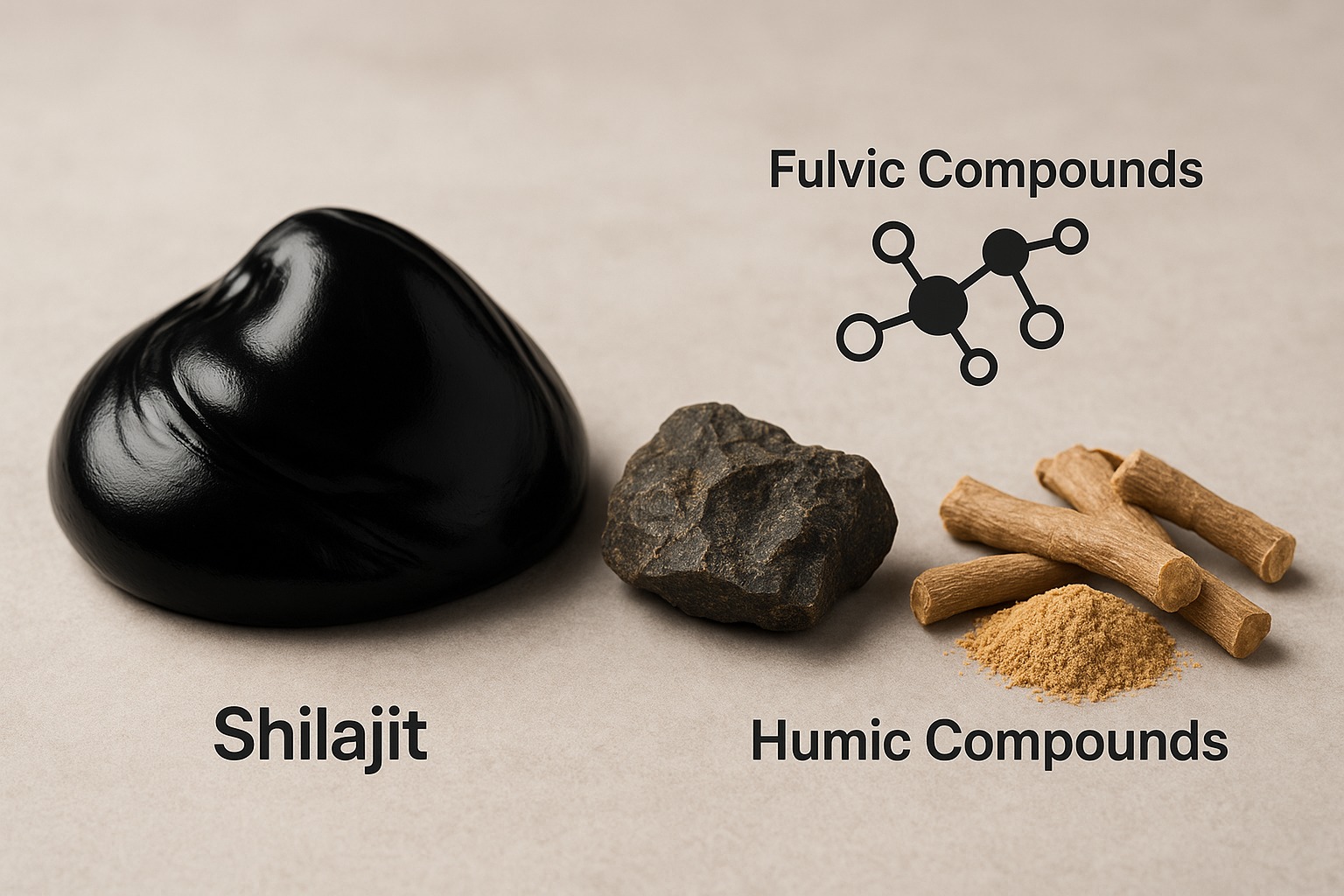
Fulvic and humic substances are natural organic compounds formed as plants and microbes slowly break down over long periods of time. When these compounds naturally bind to trace elements like magnesium, zinc, or iron, people often refer to the mixture as fulvic minerals. In Shilajit, fulvic minerals are part of a broader natural matrix that also includes humic substances, trace minerals from rock, and other small organic molecules.
- Fulvic minerals: Trace minerals naturally bound to fulvic compounds, usually water-soluble and found in soil, compost, and deposits like Shilajit.
- Humic compounds: Larger, darker fractions from the same long-term plant breakdown process.
- In Shilajit: Fulvic minerals and humic substances appear together in varying proportions depending on origin and purification.
What are fulvic minerals?
Fulvic compounds are small organic molecules produced as plant material slowly decomposes. Because they can loosely bind to trace elements and remain soluble in water across a wide pH range, they are often marketed as fulvic minerals or as a fulvic acid supplement when extracted and bottled on their own.
In a natural setting—soil, compost, and Shilajit—these fulvic compounds are not isolated. They exist as part of a complex mixture, interacting with minerals, other organic acids, and humic substances.
- Origin: Form over long periods from the breakdown of leaves, roots, and other plant matter.
- Solubility: Tend to dissolve easily in water, helping disperse trace minerals as fulvic minerals.
- In nutrition: Often discussed for potential support in transporting minerals; research is ongoing and does not turn fulvic minerals into a cure or treatment.
- In supplements: A fulvic acid supplement may be made from concentrated humic substances, from Shilajit, or from other organic deposits.
Fulvic minerals in Shilajit vs standalone fulvic acid supplements
In Shilajit, fulvic compounds, humic substances, and naturally occurring minerals combine into a resinous mass that seeps from rock over warm seasons. When people talk about Shilajit as a source of fulvic minerals, they are really describing this whole combination rather than one isolated ingredient.
| Component or product | Where it comes from | How brands typically describe it |
|---|---|---|
| Fulvic minerals in Shilajit | Fulvic compounds formed from ancient plant material, naturally bound to trace minerals within mountain rock layers. | Often highlighted as part of “mineral-rich Shilajit,” not as a separate ingredient on its own. |
| Isolated fulvic acid supplement | Fulvic fraction extracted and concentrated from humic substances, Shilajit, or other organic deposits. | Marketed as “fulvic minerals” or “liquid fulvic acid” with a focus on ease of mixing into water or juice. |
| Humic compounds | Form alongside fulvic substances from the same plant decomposition process. | Sometimes mentioned on labels, but more often kept in the background while fulvic numbers are emphasized. |
| Trace minerals | Originate from the surrounding rock and soil environment. | Used to support the idea of a broad-spectrum mineral profile in both Shilajit and some fulvic mineral blends. |
Choosing a fulvic acid supplement or Shilajit product
Many products advertise very high “fulvic acid” percentages or use phrases like “100% fulvic minerals.” Methods for measuring these compounds vary, and the percentage alone does not guarantee quality or safety—for either a fulvic acid supplement or a Shilajit resin.
- Look beyond the %: A single fulvic percentage doesn't show heavy metal safety, microbial control, or authenticity.
- COA focus: Ask for a batch-specific Certificate of Analysis (COA) that covers heavy metals, microbials, and identity testing—not just fulvic numbers.
- Source clarity: For Shilajit, brands should share geographic origin and purification steps. For liquid fulvic minerals, they should explain what the fulvic fraction was extracted from.
- Serving guidance: Responsible products, whether resin or fulvic acid supplement, provide realistic serving suggestions rather than extreme claims.
Common myths & calm facts about fulvic minerals
-
Myth: “Only ultra-high fulvic % products are worth buying.”
Reality: Genuine Shilajit and fulvic mineral products can have a range of fulvic percentages. Quality depends on source, purification, and safety testing, not one headline number. -
Myth: “A fulvic acid supplement is the same thing as Shilajit.”
Reality: Shilajit is a whole resin matrix containing fulvic minerals plus humic substances and other naturally occurring components. Isolated fulvic acid supplements are related, but they are different ingredients. -
Myth: “More fulvic minerals automatically mean stronger health effects.”
Reality: Human responses are complex, and research is still developing. No single fulvic or humic measurement guarantees specific health outcomes. -
Myth: “Any dark liquid labeled fulvic is safe and equivalent.”
Reality: Dark color alone doesn't prove purity. Without COA-backed testing, a product labeled “fulvic minerals” could contain contaminants or very different compositions.
Organic Shilajit vs Natural Shilajit
Authoritative Sources & Research Context
Third-party testing and Certificates of Analysis (COA) are important for verifying Shilajit quality. Understanding what to look for in testing helps consumers make informed choices.
Authoritative Sources
-
National Library of Medicine (NLM) – PubMed – A Comprehensive Review on Shilajit: What We Know about Its Chemical Composition.
PubMed – Shilajit Composition -
ACS Omega – Chemical Analysis of Native Himalayan Shilajit.
ACS Omega – Shilajit Chemistry -
ScienceDirect – Shilajit-Analytical Study to Understand the Phytocomplex.
ScienceDirect – Shilajit Analysis -
PubMed Central (PMC) – Evaluation of safety profile of black shilajit after 91 days.
PMC – Shilajit Safety -
Journal of Population Therapeutics & Clinical Pharmacology – Systematic Review: Clinical Efficacy and Safety.
JPTCP – Shilajit Review -
Examine.com – Shilajit Evidence-Based Review.
Examine.com – Shilajit
This section is for general informational purposes only and is not a substitute for professional medical advice.
FAQs about fulvic minerals, fulvic acid supplements & Shilajit
Are fulvic minerals the main “active” in Shilajit?
Should I choose Shilajit or a fulvic acid supplement?
Do higher fulvic mineral percentages mean a better product?
Are fulvic and humic substances considered medicines?
Continue Learning About Shilajit & Fulvic Minerals
Next steps
If fulvic minerals and Shilajit interest you, use that curiosity to ask clearer questions: Where is this resin or fulvic acid supplement sourced from? How is it purified? Can I see a recent COA? Then, if you and your healthcare professional decide it makes sense, build a simple, consistent routine instead of chasing ever-higher numbers on the label.
Shop Pure Himalayan ShilajitThese statements have not been evaluated by the FDA. This product is not intended to diagnose, treat, cure, or prevent any disease. Always consult a qualified healthcare professional before using any Shilajit or fulvic acid supplement.