
Shilajit vs Ashwagandha: Differences, Uses & Safety
Shilajit and ashwagandha often appear side by side in supplement ads and videos, as if they do the same thing or can be swapped one-for-one. In reality, they are different substances with different traditions, compositions, and safety questions. This guide walks through how they compare, how people talk about them, and how to bring both names into a grounded conversation with your healthcare professional.
Quick Comparison: Shilajit vs Ashwagandha
In plain language:
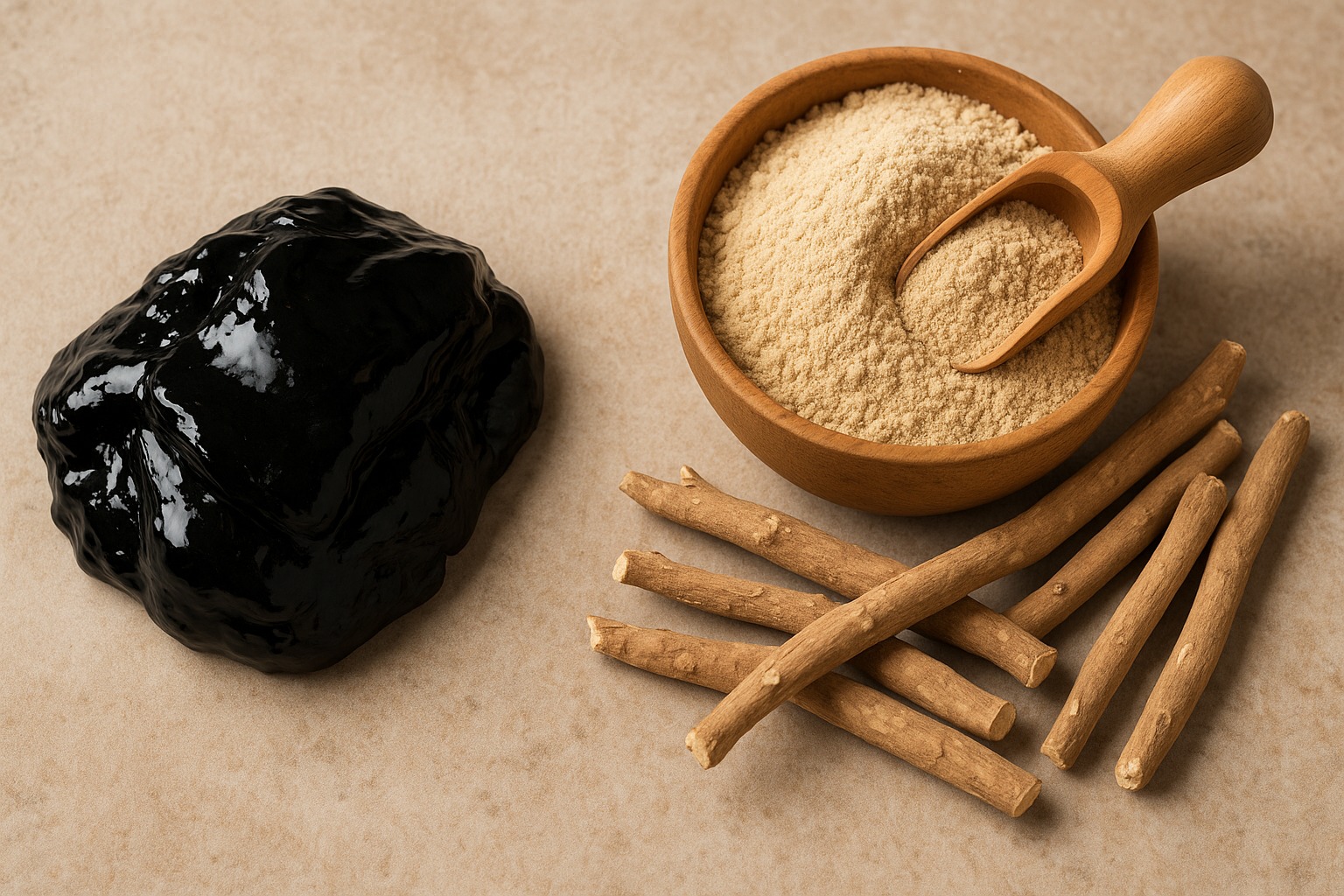
- Shilajit is a natural mountain resin—a dense, mineral-rich substance that forms over time inside rocks.
- Ashwagandha is a plant (Withania somnifera), traditionally used as a root powder or extract.
- They come from different parts of nature (resin vs root), are processed differently, and play different roles in traditional systems.
- Choosing between them—or deciding whether to use either—should be based on your health situation, not social media lists.
What Is Shilajit?
Shilajit is a dark, sticky resin that slowly emerges from high-altitude rocks when temperatures warm. It forms over long periods of time from compressed plant material mixed with minerals in mountain environments.
After purification and testing, some people use tiny portions of Shilajit resin dissolved in warm water, milk, or tea as part of a ritual or routine.
- Natural mountain resin, not a leaf or root
- Contains humic and fulvic components plus minerals
- Used in very small, concentrated portions
- Requires careful sourcing and testing
Deep-Dive Shilajit Guides
Whole natural resinWhat Is Ashwagandha?
Ashwagandha (Withania somnifera) is a plant in the nightshade family. Traditionally, the root is dried and prepared as a powder or decoction; modern supplements often use standardized extracts in capsules, tablets, or gummies.
It is frequently discussed in wellness spaces in the context of stress, sleep, or energy—but those conversations can easily slide into medical claims, which this page avoids.
- Herbal root, not a resin
- Contains plant compounds like withanolides (discussed in research contexts)
- Available as powders, capsules, tinctures, and blends
- Often combined with other herbs in formulas
Typical Ashwagandha Products
- Capsules with standardized root extract
- Loose powder to mix into drinks or food
- Liquid extracts (tinctures or drops)
- Multi-ingredient “stress support” blends
Key Similarities Between Shilajit & Ashwagandha
While they are very different substances, Shilajit and ashwagandha share a few broad themes in how they’re discussed online:
Shared Themes
- Both are rooted in long-standing traditional practices.
- Both are sold as dietary supplements, not as approved medicines.
- Both are frequently promoted in the context of energy, mood, or performance—sometimes with exaggerated claims.
- Both deserve safety screening for your health history and medications.
How People Often Use Them
- As part of a broader wellness routine
- In small daily servings, or in cycles
- Alongside lifestyle changes such as sleep and nutrition work
The overlap in marketing does not mean they are interchangeable. It simply shows that both sit in the same general “traditional wellness supplement” category in people’s minds.
Key Differences: Shilajit vs Ashwagandha
This table highlights some practical differences between Shilajit resin and ashwagandha root–based supplements. It is not a list of benefits or medical uses—just structure, form, and safety-relevant context.
| Aspect | Shilajit (Purified Resin) | Ashwagandha (Root-Based) |
|---|---|---|
| Source | Natural mountain resin formed in rock layers from ancient organic matter and minerals. | Plant root from Withania somnifera, grown in soil and harvested like other herbs. |
| Nature of substance | Complex resin with humic/fulvic components and minerals. | Botanical with plant-derived compounds such as withanolides (discussed in research contexts). |
| Traditional preparation | Collected from rocks, purified, and used in tiny resin portions. | Root dried and used as powder, decoction, or in multi-herb formulas. |
| Typical modern forms | Resin in jars or sticks; some powders, capsules, and gummies that claim to contain Shilajit. | Capsules, powders, gummies, liquids, and blends with other herbs. |
| Serving size style | Small “pea-sized” or “rice-sized” portions of resin, within label guidance. | Measurable capsule counts, teaspoons of powder, or dropper amounts, per product instructions. |
| Main safety focus | Purity, heavy-metal tests, proper resin identification, and kidney/liver considerations. | Dose, extract strength, interactions with medications, and hormone / nervous-system considerations. |
| Label red flags | Unrealistic cure-all claims, no testing, tar-like impostors, extremely low prices. | Very high “extra strong” doses, unsupported disease claims, vague sourcing, no testing. |
Forms & How People Typically Use Them (Non-Medical)
How a supplement is taken matters—both for comfort and for safety. This section only describes common patterns; it is not a recommendation.
Shilajit Resin
- Small, measured resin portion (often pea- or rice-sized) within label guidelines.
- Dissolved in warm water, milk, or tea until fully blended.
- Typically once per day, sometimes cycled with breaks.
- Best discussed with a clinician, especially for kidney/liver history.
Ashwagandha Supplements
- Capsules or tablets taken with water, per label directions.
- Powders mixed into smoothies, warm milk, or other foods.
- Sometimes taken in the evening, sometimes earlier—depends on the person and the product.
- Should be reviewed with a clinician if you take medications or have medical conditions.
For more details on Shilajit use patterns (without prescribing specific doses), see How to Take Shilajit and Shilajit Dosage: Safe Portion Guide.
Which to Consider (or Avoid)? A Safety-First View
Instead of asking “Which is stronger?” or “Which works better?”, it’s more helpful to ask:
Questions for Yourself
- What do I actually want to change or support?
- Have I already worked on basics like sleep, food, movement, and stress?
- Am I looking for a quick fix or a gentle experiment?
- Do I have the ability to get lab work and clinical follow-up if needed?
Questions for Your Clinician
- “Given my history and labs, would you prefer Shilajit, ashwagandha, neither, or something else?”
- “Do either of these raise concerns with my current medications?”
- “If we try one, what serving pattern and monitoring make sense?”
- “What non-supplement strategies should we prioritize first?”
In many cases, the safest and most realistic answer is that neither Shilajit nor ashwagandha is essential, and that foundation habits and medical care deserve more attention than any single supplement.
Can You Use Shilajit & Ashwagandha Together?
Some products and routines combine Shilajit and ashwagandha, framing them as a “stack.” This can feel appealing, but it also raises safety questions.
Why Combining Requires Extra Care
- More variables if you feel “off” or develop side effects.
- Higher overall supplement load on kidneys, liver, and other systems.
- Greater chance of interacting with medications or underlying conditions.
- Harder for your clinician to interpret what is contributing to what.
If Your Clinician Still Approves a Combination
- Introduce one product at a time, not both on day one.
- Use modest, label-guided servings—no “megadoses.”
- Keep a simple log of mood, sleep, digestion, and energy.
- Be ready to stop both if new symptoms appear.
If you don’t have access to regular medical follow-up, combining multiple strong supplements is usually not a cautious choice.
Safety & Who Should Be Especially Cautious
Both Shilajit and ashwagandha deserve respect when it comes to safety. They can be powerful additions on top of everything else your body is already handling.
Groups That Often Need Extra Caution
- People who are pregnant, trying to conceive, or breastfeeding
- Children and teenagers (use only under pediatric guidance)
- Anyone with kidney, liver, or serious heart conditions
- People with hormone-related or autoimmune conditions
- Individuals taking multiple prescription medications
Red-Flag Symptoms (Either Supplement)
- Shortness of breath, chest pain, or palpitations
- Severe abdominal pain, vomiting, or dark urine
- Yellowing of skin or eyes
- Swelling of face, lips, or tongue, or difficulty breathing
- Sudden, severe mood or sleep changes
These kinds of symptoms deserve urgent medical attention, whether or not you are sure a supplement is involved.
For more Shilajit-specific context, see Is Shilajit Safe? and Shilajit Side Effects & Safety.
Authoritative Sources & Research Context
Both Shilajit and Ashwagandha are traditional Ayurvedic substances with distinct properties and uses. Understanding each helps inform decisions about supplementation.
Authoritative Sources
-
National Library of Medicine (NLM) – PubMed – Shilajit: a review.
PubMed – Shilajit Review -
PubMed Central (PMC) – Shilajit: A Natural Phytocomplex with Potential Procognitive Activity.
PMC – Shilajit Phytocomplex -
Verywell Health – Shilajit vs Ashwagandha Comparison.
Verywell Health – Shilajit vs Ashwagandha -
ScienceDirect – Review on shilajit used in traditional Indian medicine.
ScienceDirect – Shilajit Traditional -
Global Research Online – Shilajit - A Wonder Drug of Ayurveda: An Overview.
Global Research – Shilajit Ayurveda -
Examine.com – Shilajit Evidence-Based Review.
Examine.com – Shilajit
This section is for general informational purposes only and is not a substitute for professional medical advice.
FAQs: Shilajit vs Ashwagandha
Is Shilajit or ashwagandha better?
Can I take Shilajit and ashwagandha at the same time?
Which one is more “natural”?
Is Shilajit stronger than ashwagandha?
Which is better for stress or energy?
Can I switch from ashwagandha to Shilajit (or vice versa)?
How do I decide if either one fits my routine?
Continue Learning About Shilajit
Use Comparisons to Ask Better Questions, Not Chase Quick Fixes
Comparing Shilajit and ashwagandha can be helpful if it leads you to clearer conversations with your doctor—not if it pushes you into collecting more jars. If you use Shilajit at all, let it be a small, transparent part of a bigger plan built on sleep, food, movement, connection, and appropriate medical care.
Explore Tested Shilajit Resin OptionsThis page is for educational purposes only and is not intended to diagnose, treat, cure, or prevent any disease. These statements have not been evaluated by the FDA. Always consult a qualified healthcare professional before using any supplement or changing your health routine.
About This Comparison Guide
Herbs Mill Research & Education Team
The Herbs Mill editorial team focuses on clear, compliance-first education about traditional resins and herbs. Our goal is to help you see supplements in context, ask better questions, and keep your healthcare professional at the center of important decisions.