
What Is Shilajit Extract? Differences, Uses & Potency Explained
When people search for Shilajit today, they often see both Shilajit resin and Shilajit extract on the same shelf. The terms sound similar, but they describe very different ways of preparing a traditional mountain resin. This guide explains what “extract” means in plain language, how Shilajit extracts are made, how they compare with classic resin, and what to look for on labels if you prefer an evidence-informed, non-hype approach.
Quick Summary: Shilajit Extract in Plain Language
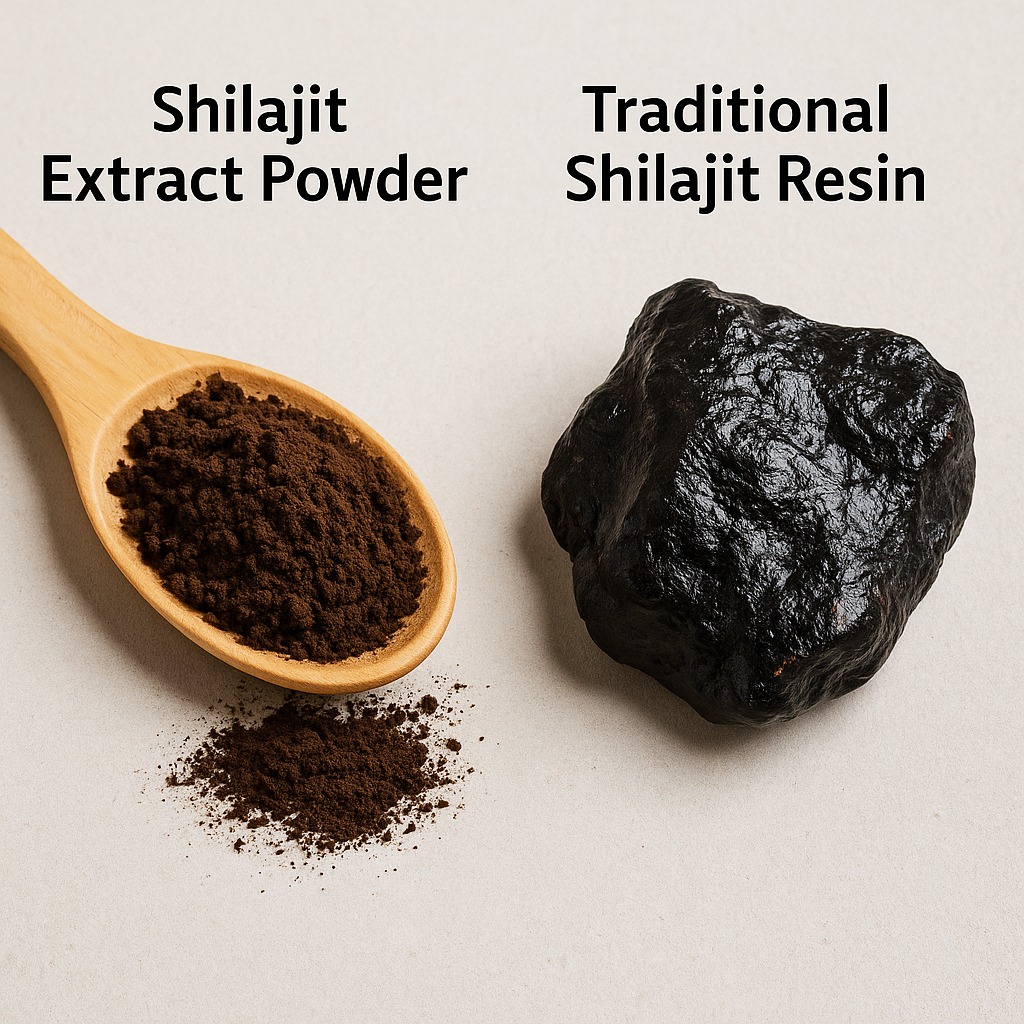
Shilajit extract usually refers to a more processed form of Shilajit where the original resin has been concentrated, standardized, or turned into a powder or capsule. The goal is often to make serving sizes simpler or to highlight specific components—such as fulvic content—rather than preserving Shilajit exactly as a traditional resin.
- Shilajit extract starts with Shilajit resin but goes through extra processing
- Extracts are sometimes standardized to certain markers (for example, fulvic content)
- Resin is closer to a traditional format; extract is a modern, convenience-focused option
- Neither format is a medicine, and neither should be used to replace medical care
What Exactly Is Shilajit Extract?
The word extract simply means that something has been drawn out and concentrated from a natural source. In the case of Shilajit, manufacturers may start with purified resin and then use controlled processes to create a more concentrated, easy-to-dose material—often a dry powder used in capsules or tablets.
Common features of Shilajit extract
- Begins with genuine Shilajit resin as the base material
- Uses water, heat, or other food-grade processes to concentrate components
- May be standardized to contain a particular range of fulvic content
- Is usually dried and turned into powder for capsules, tablets, or blends
How labels might describe extract
- “Shilajit extract 10:1” or “20:1” (ratio-based concentration)
- “Standardized Shilajit extract” with a listed percentage of key components
- “Shilajit extract blend” combined with other botanicals
- Mentions of “fulvic content” or “humic substances” in measured ranges
How Shilajit Extracts Are Made (General Process)
Every manufacturer has their own methods, and the details are usually proprietary. Still, most processes follow the same basic idea: take purified Shilajit resin, concentrate selected components, and transform the result into a stable format that fits into modern supplement routines.
- Start with purified resin. Authentic Shilajit is collected as raw mountain resin and then purified to remove debris and obvious contaminants.
- Further concentrate or fractionate. Water and heat—or other food-grade techniques—are used to concentrate certain natural fractions.
- Dry the concentrate. The concentrated material is gently dried into a powder or granules.
- Standardize and test. Target ranges of key markers (often fulvic content or humic substances) are measured and adjusted if needed.
- Encapsulate or blend. The final extract is put into capsules or mixed into formulas with other ingredients.
None of these steps automatically make one product “better” or “worse”; they simply create a different format. The important part is how carefully the process is controlled and tested.
Shilajit Extract vs Traditional Resin
Many people wonder whether they should use extract or resin. Instead of seeing one as universally superior, it is more helpful to understand how they differ in feel, format, and philosophy. Resin is closer to the traditional experience; extract is closer to modern, standardized supplementation.
| Aspect | Traditional Resin | Shilajit Extract |
|---|---|---|
| Format | Sticky, tar-like resin that you dissolve in warm liquid | Dry powder in capsules, tablets, or blends |
| Processing level | Purified but still close to natural form | Further processed and concentrated |
| Standardization | Composition can vary by batch and region | Often standardized to a target marker range |
| Convenience | Requires scooping, dissolving, and careful measuring | Pre-measured capsules or tablets are easier for many people |
| Traditional feel | Closer to how Shilajit has been used historically | Modern approach focused on portion control and consistency |
If you value tradition and minimal processing, you may lean toward resin. If you prioritize convenience and standardized markers, an extract may fit better—as long as you still keep expectations realistic and review safety information first.
Potency, Ratios & Standardization in Shilajit Extracts
One reason people are drawn to Shilajit extract is the idea of “stronger” or more concentrated servings. However, potency labeling can be confusing without a bit of context. Common approaches include extract ratios and standardized percentages.
Understanding extract ratios (e.g., 10:1)
- A “10:1” ratio may mean 10 parts raw material were used to make 1 part extract
- Ratios describe concentration steps, not guaranteed effect size in the body
- Different manufacturers calculate ratios in slightly different ways
- A higher ratio does not automatically make a product safer or more appropriate
Standardized markers (for example, fulvic content)
- Some extracts list a range of fulvic content or total humic substances
- Standardization can help keep batches more consistent over time
- Markers are measured in the lab and reported on the Certificate of Analysis (COA)
- Values should be interpreted with safety, not just “more is better,” in mind
Quality, Safety & Label Reading for Shilajit Extract
Because Shilajit comes from mountain rock layers, quality and testing are especially important—whether you choose resin or extract. With extracts, you are relying even more on the manufacturer’s controls and standards, so transparent testing becomes non-negotiable.
Essential quality checks
- Third-party testing for heavy metals and microbial safety
- Clear labeling of origin, lot number, and serving size
- Reasonable, not exaggerated, claims about benefits and hormones
- Access to a recent Certificate of Analysis (COA) on request or online
Helpful label details for extracts
- Exact amount of Shilajit extract per capsule or serving
- Any extract ratio or standardized marker explained in plain language
- Other ingredients listed (fillers, binders, or added botanicals)
- Usage notes that emphasize gradual use and professional guidance
For more on evaluating quality and authenticity, you can also read Pure Shilajit Resin and Shilajit Testing & Certification (COA) as complementary guides.
Who Might Prefer Shilajit Extract Formats?
There is no single “right” version of Shilajit for every person. Some people appreciate the traditional ritual of measuring resin; others want a simple capsule they can take with breakfast. Your preferences, schedule, and comfort level with taste and texture all play a role.
Shilajit extract may suit people who:
- Prefer capsules or tablets over sticky resins
- Want pre-measured servings to reduce guesswork
- Travel frequently and need something easy to pack
- Appreciate standardized marker ranges for consistency
Traditional resin may suit people who:
- Enjoy a more traditional, minimally processed format
- Don’t mind tasting and dissolving the resin in warm liquids
- Like seeing and handling the material directly
- Prefer to keep additional ingredients (fillers, binders) to a minimum
Limitations: What Shilajit Extract Cannot Do
Even though Shilajit extract may feel more concentrated or “advanced,” its limitations are the same as any other Shilajit format. It should be seen as a traditional wellness option—not a shortcut, not a cure, and not a replacement for medical care.
Shilajit extract does not:
- Treat, cure, or prevent diseases
- Guarantee changes in hormones, performance, or body composition
- Replace medical evaluation, diagnosis, or prescribed treatments
- Override fundamentals like sleep, nutrition, and stress management
It can reasonably be viewed as:
- A modern format derived from a traditional mountain resin
- One potential way for adults to explore Shilajit in a portion-controlled form
- Something to consider alongside professional guidance, especially with health conditions
- Part of a broader lifestyle approach rather than a stand-alone “solution”
Authoritative Sources & Research Context
Researchers and clinicians continue to explore how Shilajit and its components behave in the body, including work with standardized extracts. These studies focus on composition, safety, and potential wellness-related pathways rather than positioning Shilajit extract as a drug.
Authoritative Sources
-
National Library of Medicine (NLM) – PubMed – Clinical evaluation of purified Shilajit in healthy volunteers, often used to inform responsible serving ranges.
PubMed – Purified Shilajit Clinical Study -
National Library of Medicine (NLM) – PubMed – Human research using Shilajit supplementation in the context of strength and fatigue.
PubMed – Shilajit & Strength Research -
PubMed Central (PMC) – Transcriptome-level exploration of how oral Shilajit influences skeletal muscle gene expression.
PMC – Shilajit Muscle Transcriptome Study -
Cleveland Clinic Health – Overview of Shilajit, including general safety and use considerations discussed by medical professionals.
Cleveland Clinic – Shilajit Overview
This section is for general informational purposes only and is not a substitute for professional medical advice, diagnosis, or treatment.
FAQs: Shilajit Extract
Is Shilajit extract stronger than Shilajit resin?
Is Shilajit extract safer than resin?
Can I switch from resin to extract using the same amount?
Does Shilajit extract work faster than resin?
Can Shilajit extract replace my medications or treatments?
Which is better for beginners: Shilajit resin or extract?
Continue Learning About Shilajit Formats & Safety
Choosing Between Shilajit Resin & Extract
If you are curious about Shilajit, the most important step is not picking the most “powerful-sounding” option, but choosing a format that fits your routine and a product that is transparent about testing. Some people start with resin to experience the traditional form; others prefer a simple, portion-controlled extract capsule. In both cases, realistic expectations and professional guidance matter more than marketing language.
Explore Purified Shilajit ResinThese statements have not been evaluated by the FDA. This page is for educational purposes only and is not intended to diagnose, treat, cure, or prevent any disease. Always consult a healthcare professional before using any supplement.
About This Guide: Shilajit Extract
Herbs Mill Research & Education Team
The Herbs Mill team focuses on clear, compliance-first education about traditional substances like Shilajit. Our goal is to explain modern formats such as Shilajit extract in realistic, non-hype terms so you can understand what you are taking, how to read labels, and how to integrate any supplement into a broader conversation with your healthcare professional.